Now Taking the Field: Baseball’s All-Time Dream Teams for All 30 Franchises

Who is the best at each position throughout the history of each major league baseball franchise?
Now Taking the Field, published in 2019 by ACTA Sports, provides robust 30-man all-time dream team rosters, selected based on Wins Above Replacement (WAR), traditional statistics, honors and awards, and post-season accomplishments.
Additional features for each all-time team include starting lineups, depth charts, comparisons with numerous past authors and fan surveys, and more.
Author: Tom Stone
614 pages paperback at Amazon
Also available on Amazon Kindle
Published by ACTA Sports
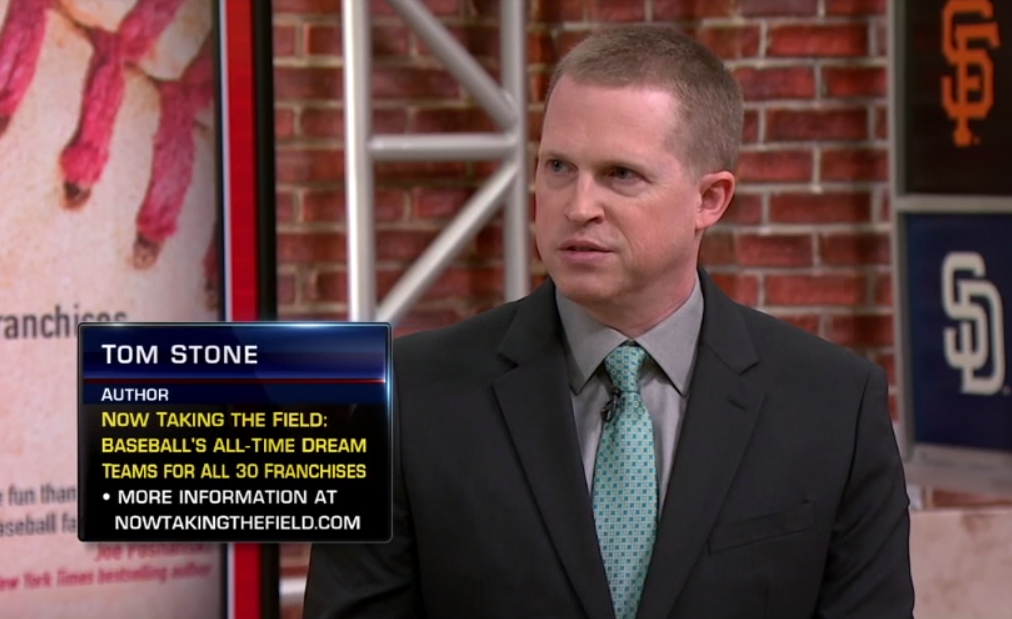
Appearance on MLB Now on the MLB Network on February 21, 2019
Tom Stone was a guest on the MLB Now show on the MLB Network on February 21, 2019. He was a panelist for the entire program, alongside host Scott Braun and analysts Joe Girardi and Dan O’Dowd. See the recording of the five-minute interview with Scott Braun, or read my write-up describing the entire show experience.


Endorsements
“A great reminder that there is nothing more fun than a good baseball argument. … Endlessly fun for baseball fans everywhere.”
Joe Posnanski, Columnist for MLB.com and New York Times bestselling author
“Fascinating and compelling and a must for any baseball fan. 5 stars!!”
Roy Firestone, 7-Time Emmy Award winner with ESPN
“This volume joins Bill James’ Historical Baseball Abstract and a few other books of its genre on an accessible bookshelf.”
Bill Brown, Broadcaster for Cincinnati and Houston for 37 years
“Here’s a book that actually answers Abbott & Costello’s questions … who’s on first, why that guy is the left fielder and the reason for today’s catcher.”
Steve Wulf, ESPN senior writer
“Stone’s knowledge and love for the game carry the reader along like a ballpark organ melody. It’s the ultimate fantasy league.”
Linda Robertson, Miami Herald columnist
See also the set of full-length endorsement quotes
614
total pages
360
stat tables
900
players chosen
Countless
debates started
The Longer Story
I started thinking about this book when I was 10 years old, in 1983. Growing up in western New York, the famously snowy Rochester winters left baseball-loving kids with few options in the winter other than trading baseball cards, playing video game versions of baseball or counting the days until pitchers and catchers reported for spring training, so I spent long hours considering who would be on all-time dream teams.
I started actually writing the book in 1999 and after nearly 20 years of on-and-off effort, the book was finally published as Now Taking the Field: Baseball’s All-Time Dream Teams for All 30 Franchises, through the publisher ACTA Sports.
Approach
My approach was to start with the popular Sabermetric statistic WAR (Wins Above Replacement) as the basis of comparing players throughout the history of the game. For each franchise, I looked at each player’s total WAR score, and also their top three WAR score seasons (for peak value) and WAR per game played (for average value over time).
I also took into account all of the traditional statistics like home runs, stolen bases, batting average, earned run average, and many more. And to round things out I paid attention to key awards like MVPs, Cy Youngs, Gold Gloves and the Rookie of the Year, as well as a player’s postseason performance.
In the end, I selected 30-player rosters for each of the 30 major league baseball franchises. By “franchise” I mean a continuously operating team through name and location changes (e.g., the Twins chapter includes their time as the Washington Senators, the Dodgers chapter includes their time in both Brooklyn and Los Angeles, etc.). The 30-player rosters are composed as follows:
16 positions players, 2 per position (with a good mix of OF)
2 “extra” position players (any position)
12 pitchers (7-10 starting pitchers, 2-5 relief pitchers)
I also listed a top-four managers for each franchise
in choosing the players, I provide the reader with both statistical tables and a brief description of each player that I considered.
Other features
Going beyond the roster choices, I then asked the question: What would starting lineups look like for each of these all-time dream teams? Lineups often look very different depending on whether a team is facing a right-handed pitcher or a lefty, so I provide two lineups for each team.
Baseball fans today like to see rosters displayed visually in the form of depth charts, so I’ve included those diagrams for each dream team as well. As an example, here is the Pirates all-time dream team depth chart:

Considering and debating baseball all-time dream teams has a long history, going back to the 1940s according to my research. So for each team, I described how my selections compare with those of other authors and fan surveys throughout the decades.
Each chapter has a few other fun features, such as listings of the best single seasons for each franchise (according to WAR score), the selection of a highest-honor franchise player, and more.
I want to thank everyone who supported my work on this project over the years, and who continue to support my writing at the Now Taking the Field newsletter. I hope readers enjoy the book and newsletter as much as I enjoy writing them, and as always I look forward to your feedback—email anytime at [email protected].